
For agency owners
11 Minute
Keeping white label work confidential: what to put in the contract and what to check in practice

The promise of white label delivery is simple: your client sees your brand and nobody else’s. Agencies worry, reasonably, about what happens if that promise breaks. A partner’s name in a report footer, a developer’s email address in a form notification, a case study that quietly names the client. None of these are dramatic, and all of them are avoidable. Here is how to keep white label work confidential in the contract and in the day to day.
What the agreement should say
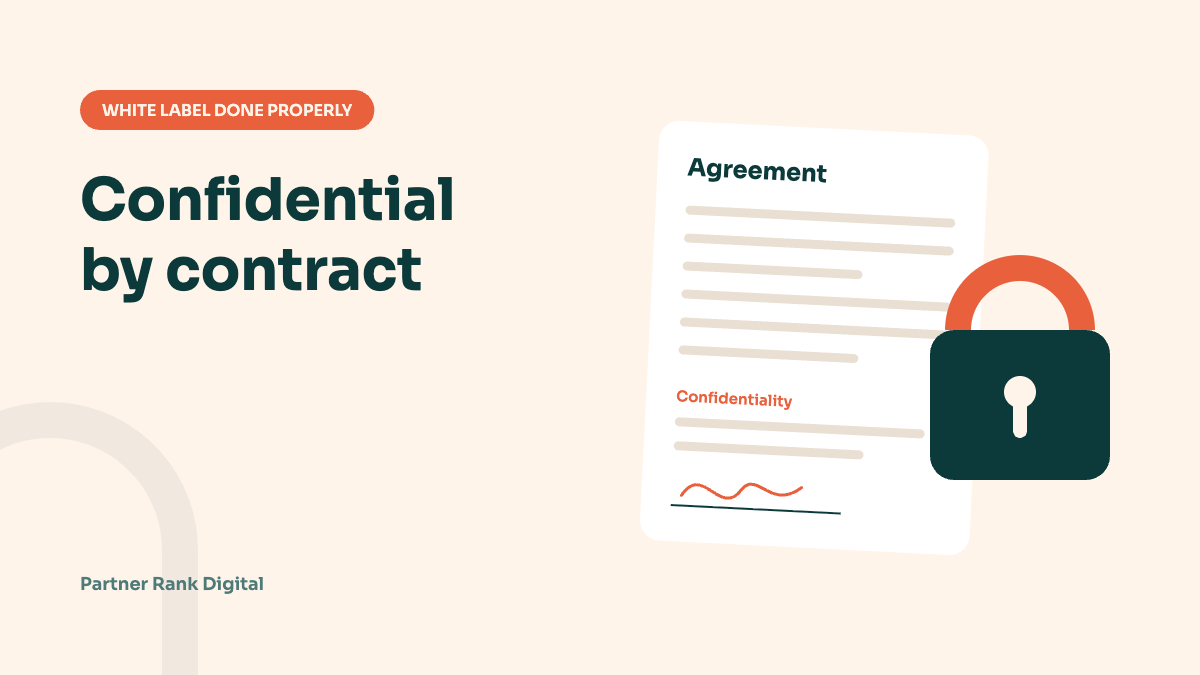
Start with a confidentiality clause that covers three things. First, the partner will not contact your clients directly unless you instruct them to in writing. Second, the partner will not identify itself as the provider of the work, in documents, on the site, in code comments or anywhere else. Third, the partner will not use your name or your clients’ names in marketing, case studies or portfolio pieces without written permission. The clause should survive the end of the agreement, because the risk does not end when the retainer does.
Add a data processing agreement if the partner will touch personal data, such as customer records in a CMS or form submissions on a site they maintain. Under the UK GDPR and the EU GDPR the partner is your processor, and the agreement sets out what they can and cannot do with that data.
Reports and documents
Every document that reaches your client should carry your branding and nothing else. Check the obvious places, like the cover page and footer of monthly reports, and the less obvious ones: PDF metadata, the author field in Word documents, and the sender name on any automated email. A good partner sends reports as templates you approve once, then reuses them.
Websites and code
On a build, look at the places a developer’s identity can leak. Theme and plugin author fields, code comments, the admin user list, the email address that receives form notifications, the Google Analytics account owner, and the DNS or hosting account. Agree at the start that all accounts are created in your agency’s name or the client’s, and that the partner works as a user inside them rather than the other way round.
Communication
Decide where the partner communicates and stick to it. Most agencies give the partner a seat in their own Slack or project tool, under an agency email address if the client can see it. The partner never joins client calls unless introduced as part of your team, and never emails a client from their own domain.
Staff and subcontractors
Ask whether the partner uses subcontractors and whether they are bound by the same terms. A confidentiality clause is only as good as the people it covers.
What to check in practice
Before a report goes out for the first time, open it as your client would. Before a site launches, search the source for the partner’s name and domain. Every few months, review who has access to the client’s accounts. This takes minutes and catches the small leaks before they become awkward conversations.
How we handle it
Confidentiality is written into every agreement we sign, our name appears on nothing, and we work inside our partners’ tools under their brand. We have delivered SEO, design and development for agencies worldwide on that basis, and we are happy to walk you through the clause before you commit. Read more about how we work, or book a call if you want to talk it through.
Tagged with :