
For agency owners
12 Minute
How to brief a white label web developer so the build comes back right first time

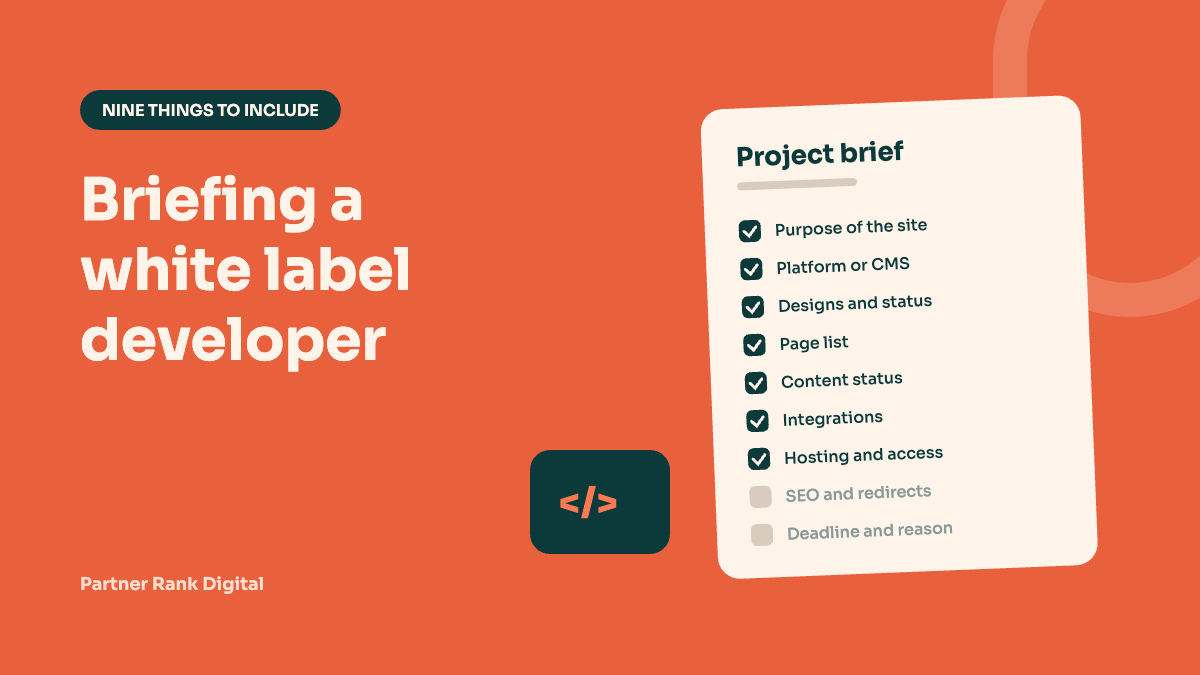
Most problems on outsourced web builds are not caused by bad developers. They are caused by briefs that leave the developer guessing. A good brief takes an hour to write and saves weeks of back and forth. Here is what to include, based on the briefs that produce the cleanest builds for our agency partners.
1. What the site is for
One paragraph on the client’s business, who the site is for, and what a visitor should do. A brochure site for a law firm and a lead generation site for a home improvement company might look similar in a design file, but they are built differently. The developer needs to know which one they are building.
2. The platform, or permission to recommend one
Say whether the site must be on WordPress, Shopify, Webflow, Wix, Squarespace, HubSpot or something else. If the client has no preference, say that too, and let the developer recommend. Platform choice affects hosting, forms, ecommerce, editing experience and cost, so it needs to be settled before anyone quotes.
3. The designs, and how final they are
Share Figma, XD or Sketch files with desktop and mobile views for every unique template. Then say how final they are. A brief that says the homepage is signed off but the inner pages may change tells the developer where to start and where to wait.
4. A page list
A simple list of every page with its template. Home, About, four service pages on the service template, a blog index, a single post template, Contact, Privacy and Terms. This is what a quote is built from, so it needs to be complete.
5. Content status
Is the copy written? Are the images chosen? Who is supplying them and when? Content is the single biggest cause of delay on agency builds. If the copy is not ready, say so, and agree whether the developer builds with placeholders and fills later, or waits.
6. Functionality beyond pages
Forms and where they send, booking or calendar tools, CRM or email integrations, ecommerce with payment and shipping rules, multilingual needs, member areas, search, and anything that talks to another system. Each of these is a line in the scope. Missing one is how a fixed quote turns into a change request.
7. Hosting and access
Where will the site live, who controls the domain, and who has the logins? If the developer is building on their staging and migrating later, they need to know that up front. If they are building directly on the client’s hosting, they need access before the start date.
8. SEO requirements
If the site is replacing an existing one, the developer needs the old URL list so redirects can be mapped. Ask for title and meta description fields, heading structure that follows the design, image compression, an XML sitemap and analytics installed. If your SEO team has a spec, attach it.
9. Deadline and the reason for it
A date is useful. A date with a reason is more useful. A launch tied to a trade show or a campaign tells the developer which parts must be perfect on day one and which can follow a week later.
The two that cause most delays
In our experience the two items most often missing are content status and third party integrations. Content because agencies assume the client will deliver it on time, and integrations because they seem small until a developer discovers the CRM has no API. Fix those two and most builds come back on schedule.
If you would like a brief template you can reuse, ask us for one. And if you have a build ready to scope, here is how a white label build runs with us.
Tagged with :